ShowerTileCourt
Elegant tiled shower interior with glass door and modern fixtures.

A bathroom storage reference

What holds it up, and what it leaves behind

Every fixture in a bathroom attaches one of 6 ways. That choice decides whether it survives steam, whether it can hold what you put on it, whether it can fall on somebody, and what is on the wall after it is gone.

Renter Check

Photo: Curtis Adams on Pexels

6 mounts, 5 zones

Every fixture attaches one of 6 ways, and every bathroom has the same 5 places worth organizing. The twelfth tile is the catalog itself.

Before anything else on this page

The tallest thing this site covers is a shelving rack that stands over a toilet tank at around five and a half feet, on a footprint a few inches deep. That is the shape of furniture that goes over, and it goes over fastest when the top shelf is loaded or when a child takes hold of the frame. Put the heavy things on the bottom shelf, and attach the unit to the wall wherever the manufacturer supplies hardware for it.

Anti-tilt systems, anti-tip devices and capacity figures are statements listings make. They are not test results and nothing here compares products against each other on safety.

CPSC Anchor It! — furniture and TV tip-over campaign

The mark

  • Adhesive mount in sectionA wall seen edge on, hatched on the far side. A flat pad is pressed against the near face, carrying a shelf that projects into the room.
    Adhesive
  • Drilled mount in sectionA wall seen edge on, hatched on the far side. A fastener passes all the way through it, with its exit point marked as a dot beyond the far face.
    Drilled
  • Hanging mount in sectionA wall seen edge on, hatched on the far side. A horizontal arm leaves the wall and a hook is taken over it, with a body hanging below.
    Hanging
  • Freestanding mount in sectionA wall seen edge on, hatched on the far side. A post stands clear of it on the floor line, carrying two shelves and touching nothing but the ground.
    Freestanding
  • Tension mount in sectionTwo walls seen edge on, facing each other. A rod spans the gap between them with arrows at both ends pointing outward into each surface.
    Tension
  • Portable mount in sectionA wall seen edge on, hatched on the far side. A handled container rests on the floor line well clear of it, touching nothing.
    Portable

A wall in section, and the 6 things that can be done to it

Every drawing on this site is the same drawing: a wall seen edge on, hatched on the far side, with the attachment method against it. Whether the pad sits flat on the surface, whether the screw passes through and comes out the other side, whether the hook takes hold of something already fixed, whether the foot reaches the floor instead.

It answers the site’s question in one glance, which is more than most product photography manages. A listing shows you a shelf full of bottles on a spotless wall. It does not show you the pad, and the pad is the entire story.

Capacity is the number listings lead with, and it is nearly always the least useful one. A shelf that states adhesive mounts and no weight limit is telling you something important by omission.

5 things a bathroom wall might be

The same adhesive pad is excellent on one of these and excluded by its own manufacturer on another. Every value below belongs to its own row.

5 surfaces against one adhesive pad
SurfaceWhat adhesive does hereWhat comes off with itDrilling
Painted drywallHolds well on sound, fully cured paint and badly on anything chalky, glossy or recently applied.Paint, and under the paint the paper face of the board. This is the surface where removal does real damage.Needs a fastener chosen for hollow board or for framing behind it. Patchable, but never a guess in a wet wall.
Ceramic tile and groutExcellent on the glazed face of a single tile. Poor across a grout line, because the pad only touches the tiles at its edges.Usually just residue on the glaze, which is the best outcome available. Grout can lose its surface where a pad was pressed into it.Effectively permanent. A hole in a glazed tile stays a hole in that tile, and matching a discontinued tile is not realistic.
Glass shower doorExcellent bond on clean, dry glass, undermined by two things glass alone has: constant movement and a hard water film.Residue only, in almost every case. Glass is the one surface here that reliably survives removal.Never. Tempered glass shatters completely when penetrated, and a shower door is tempered by law.
Fiberglass and acrylic surroundHolds on the flat panels, poorly on the molded curves and the textured floor, and every bond is loaded by panel flex.The gloss finish can dull or mark in the shape of the pad. Not a glaze, so it does not survive removal the way tile does.A hole through a waterproof shell, into a cavity you cannot see. This is a plumbing decision, not a shelf decision.
Textured paint and wallpaperIt does not work. Texture leaves the pad touching only the high points, and wallpaper hands you a surface that peels by design.A strip of wallpaper, or a plug of texture compound. Whatever the pad is stuck to comes with it, because that layer is the weak link.Mechanically the same as the wall underneath. Cosmetically worse, because patched texture and matched wallpaper rarely disappear.

Tool

Renter Check

Three questions. It returns a mount, the reason that mount suits your wall, how it fails on that surface, and what is left behind when it comes off.

What is the wall or floor made of

What are you putting up

Does it have to come off when you leave

Hanging mount in sectionA wall seen edge on, hatched on the far side. A horizontal arm leaves the wall and a hook is taken over it, with a body hanging below.

Use this mount

Hanging mounts

It has to come off, and this surface is one where removing an adhesive pad takes paint, gloss or paper with it. Hang it instead, from a door, a rod or the shower arm, so nothing bonds to the wall in the first place.

What it holds
Whatever the host component holds, minus a margin, through a hook in pure downward load.
How it fails on painted drywall
Ideal, because the wall carries nothing. Marks where it swings and touches, and that is the extent of it.
What is left after you take it off
Scuffs where it swung against the wall, and wear marks on the host component. On this surface specifically: Paint, and under the paint the paper face of the board. This is the surface where removal does real damage.
All 2 listings in this catalog with this mount

Three things this answer does not change. Adhesive can pull paint off a wall when it comes away. Holes drilled in tile are effectively permanent, because matching a discontinued tile is not realistic. And what you are allowed to fix to a wall is decided by your own tenancy agreement, which you should read: this site does not give legal advice.

The rules this tool applies, in order

  1. A mat on the floor is not mounted to anything, so the surface of your walls has no bearing on it. The answer is always portable.
  2. A rack over the toilet carries its load into the floor through its own feet. The wall behind it does not hold it up, so the wall surface does not change the answer. It is always freestanding, and it is always a tipping question rather than a bonding question.
  3. It has to come off, and this surface is one where removing an adhesive pad takes paint, gloss or paper with it. Hang it instead, from a door, a rod or the shower arm, so nothing bonds to the wall in the first place.
  4. It has to come off, and this surface is glazed tile or glass, where removing an adhesive pad usually leaves residue rather than damage. Adhesive is the reasonable choice here, fitted inside a single tile where the surface is tiled.
  5. It can stay, but this surface cannot be drilled under any circumstances, because tempered glass shatters completely when it is penetrated. Adhesive is the only fixed option on a glass panel.
  6. It can stay, so the strongest mount this surface allows is a fastener through the wall. That is permanent, and in tile it is permanent in a way that shows. This site gives no drilling instructions and no advice about what your lease permits.

What this mount answer does not take into account

  • What your tenancy agreement actually says. This tool reads none of it, and this site does not give legal advice.
  • The weight of what you are putting up. No listing in this catalog states a weight limit except one, and a mount that suits your wall can still be overloaded.
  • The condition of your particular wall: how old the paint is, whether it was applied over wallpaper, whether the tile is loose, whether the grout is sound.
  • What is inside the wall. That question decides whether drilling is even a possibility, and it is not one a web page can answer for you.
  • Tension mounts, which this tool never recommends. Friction on a wet surface is the wrong mechanism for a bathroom, and it is covered on its own page.

Four numbers counted from the catalog

None of these were typed into the copy. They are counted at build time, which is why two of them are unflattering.

  • 46

    listings

    Every one of them quoted from its own listing.

  • 6

    mount types

    Every fixture in a bathroom attaches one of these ways.

  • 17

    state a measurement

    The rest print no dimensions at all, and this catalog says so rather than guessing.

  • 1

    states a load figure

    One listing prints a capacity. It is the seller’s number, not a test result.

Tool

Tip-Over Check

Four questions about a tall rack, and a count of how many known tip-over factors apply to the way yours is set up. It is a count, not a measurement, and it cannot tell you that anything is safe.

How tall is the rack

What goes on the top shelf

Children or animals in the home

Does the listing state wall-attachment hardware

Risk factors counted

3 of 7

Some of these factors present

More than one of the factors below applies to your arrangement. Each one you can remove is worth removing, starting with what is on the top shelf.

Where that total came from
FactorPoints
A stated height of 64 in or more2
Only light bulky things on the top shelf0
No children or animals in the household0
No wall-attachment hardware stated on the listing1

The total counts factors that turn up in tip-over incidents. It is not a stability measurement, it is not a rating of your rack, and it cannot tell you that anything is safe. The lowest total this tool can produce is 1, because every rack height stated in this catalog is tall enough to score on height alone.

What to do, in this order

  1. Move the heaviest things off the top shelf and put them on the bottom one. This is the only change on this list that costs nothing and takes a minute.
  2. Attach the unit to the wall wherever the manufacturer supplies the hardware to do it. If no hardware came in the box, there is nothing to fit and the unit stands on its feet alone.
  3. Your listing states no wall-attachment hardware, so anchoring is not an option this unit gives you. That makes where the weight sits the only lever you have.
  4. Check that all four feet are actually touching the floor. A rack rocking on three of them is a rack waiting for a nudge.

The U.S. Consumer Product Safety Commission runs a public campaign on furniture tip-overs: CPSC Anchor It! — furniture and TV tip-over campaign.

The arithmetic, written out

  • Height: a stated 63 in or more scores 2, a height the listing does not state scores 1, and a stated height below 63 in scores 0. The 63 in figure is taken from the shortest stated height in this catalog, not chosen by hand.
  • Top shelf: heavy scores 2, moderate scores 1, light and bulky scores 0.
  • Household: children or animals in the home scores 2, neither scores 0.
  • Hardware: a listing that states no wall-attachment hardware scores 1, one that states it scores 0.
  • The four scores are added. Across every combination this tool can produce, the total runs from 1 to 7, and that range is counted from the options themselves rather than typed in. It does not start at zero, because every rack height stated in this catalog is above the 63 in threshold and so scores at least one point on height alone.
  • The range is split into four equal bands at 2.5, 4.0, 5.5. A total at or below the first edge falls in the first band, and so on up.

What this count does not take into account

  • Whether your rack is stable. This is a count of known risk factors, not a measurement, and nothing here can tell you that a rack will stay upright.
  • The construction of the unit itself: how wide its feet are, how it is braced, how heavy the frame is. None of the listings state those things.
  • Your floor. A rack standing on three of its four feet on an uneven tile floor is a different object from the same rack on a flat one.
  • What a stated capacity means. A listing that states 150 lb is telling you a number the seller chose to print, with no stated split between shelves and no stated test.
  • Whether you can actually attach the unit to your wall, which depends on what that wall is made of and what runs behind it.

6 plain answers

Which mount is best?
None of them, in general. Each one is best at something and disqualified somewhere. The useful question is what your wall is made of and whether the thing has to come off again, which is two questions and takes about a minute to answer.
Why does an adhesive shelf fall off?
Usually one of three things: it was loaded before the manufacturer’s cure time was up, it was stuck to something it was never rated for, or the weight sat far enough from the wall to peel the top of the pad away rather than hang from it.
Can I drill into bathroom tile?
Physically yes, and this site will not tell you how. Behind that tile there are supply pipes, a drain stack and electrical runs, and the two failure modes are a flood and a shock. If you do not already know what is behind the wall, this is work for somebody who can find out.
Will a tall rack over the toilet tip over?
It can. It is tall, narrow, top-heavy furniture standing on a shallow footprint in a room with a hard floor. Keep the heavy things on the bottom shelf and use the wall-attachment hardware where the manufacturer supplies it.
Does non-slip backing stop a mat sliding?
Non-slip is a word a seller writes about a rubber compound. It is not a measurement, no listing here has a test result behind it, and the grip falls away as the backing ages and after every wash. A wet floor is slippery regardless.
What comes off the wall when I remove the mount?
On glazed tile or glass, usually residue and nothing worse. On painted drywall, paint and sometimes the paper face under it. On an acrylic surround, the gloss in the shape of the pad. On wallpaper, the wallpaper. Nobody can promise a clean removal.

6 listings, one from each category

The rest of the 46 are in the catalog. Each of these is the listing that most directly addresses its category’s job, and the reasoning for that placement is printed on the category page.

Product links on this site go to Amazon and carry an affiliate tag, so a qualifying purchase earns this site a commission at no additional cost to you. That arrangement pays for the site and has no bearing on what is written here: nothing was tested, no listing paid for placement, and the ordering is explained in full on each catalog page.

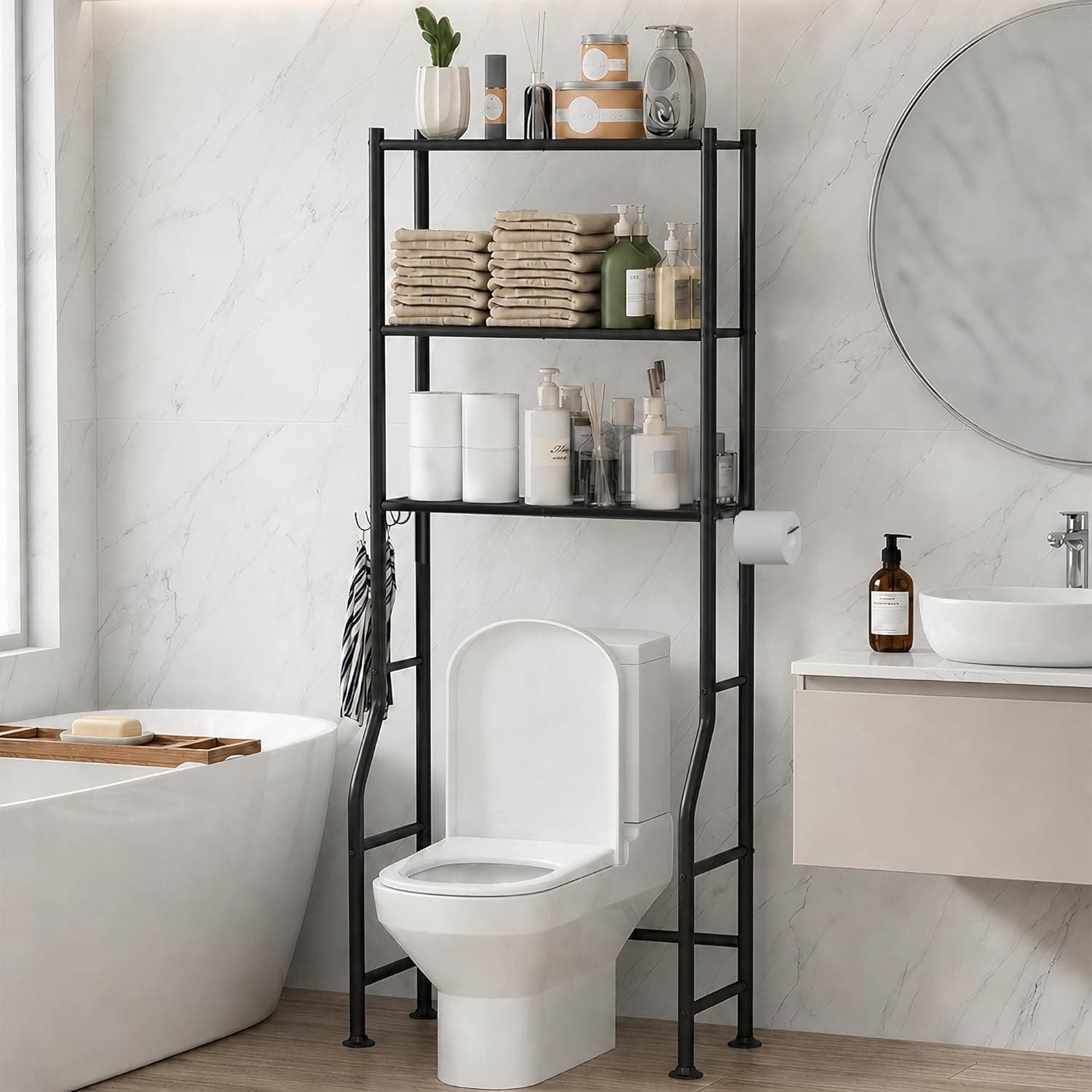
GloTika 3-Tier Over-Toilet Storage, 64 in

Tallest listed height

A stated 64 in. That number appears on exactly one listing in this category and is the highest height stated here.

GloTika 3-Tier Over-Toilet Storage, 64 in

Freestanding mount in sectionA wall seen edge on, hatched on the far side. A post stands clear of it on the floor line, carrying two shelves and touching nothing but the ground.
Freestanding

The listing states an anti-tilt system, 150 lb capacity, carbon steel, no drilling, an anti-rust coating, a paper holder and 4 hooks.

Three shelves on a carbon steel frame that straddles the tank and rests on the floor, so nothing goes into the tile. The listing states a 64 inch height, an anti-tilt system, a 150 lb capacity, an anti-rust coating, a paper holder and four hooks. The anti-tilt and capacity figures are the seller’s words and were not measured by anyone here.

Stated size
64 in tall (per listing)
Stated capacity
150 lb (listing claim, not a tested figure)
More on the GloTika 3-Tier Over-Toilet Storage, 64 in

In its favor

  • At a stated 64 in, this is the tallest height printed on any listing in this group.
  • Carbon steel with an anti-rust coating, per the listing, which matters in a room that stays damp.
  • The listing includes a paper holder and four hooks, so the uprights carry load the shelves would otherwise take.
  • Nothing is drilled, so the tile and the drywall behind the tank stay closed.

Against it

  • A 64 inch frame on a narrow floor footprint is the exact shape that goes over when the top shelf is loaded or a child pulls on it.
  • The 150 lb figure is a listing claim with no stated split between the three shelves.
  • The listing does not state a footprint depth, so clearance between the frame and the tank is unknown until it is in the room.

Best for

A renter who wants three shelves of height over the tank, cannot put holes in the wall, and will keep the heavy things at knee level.
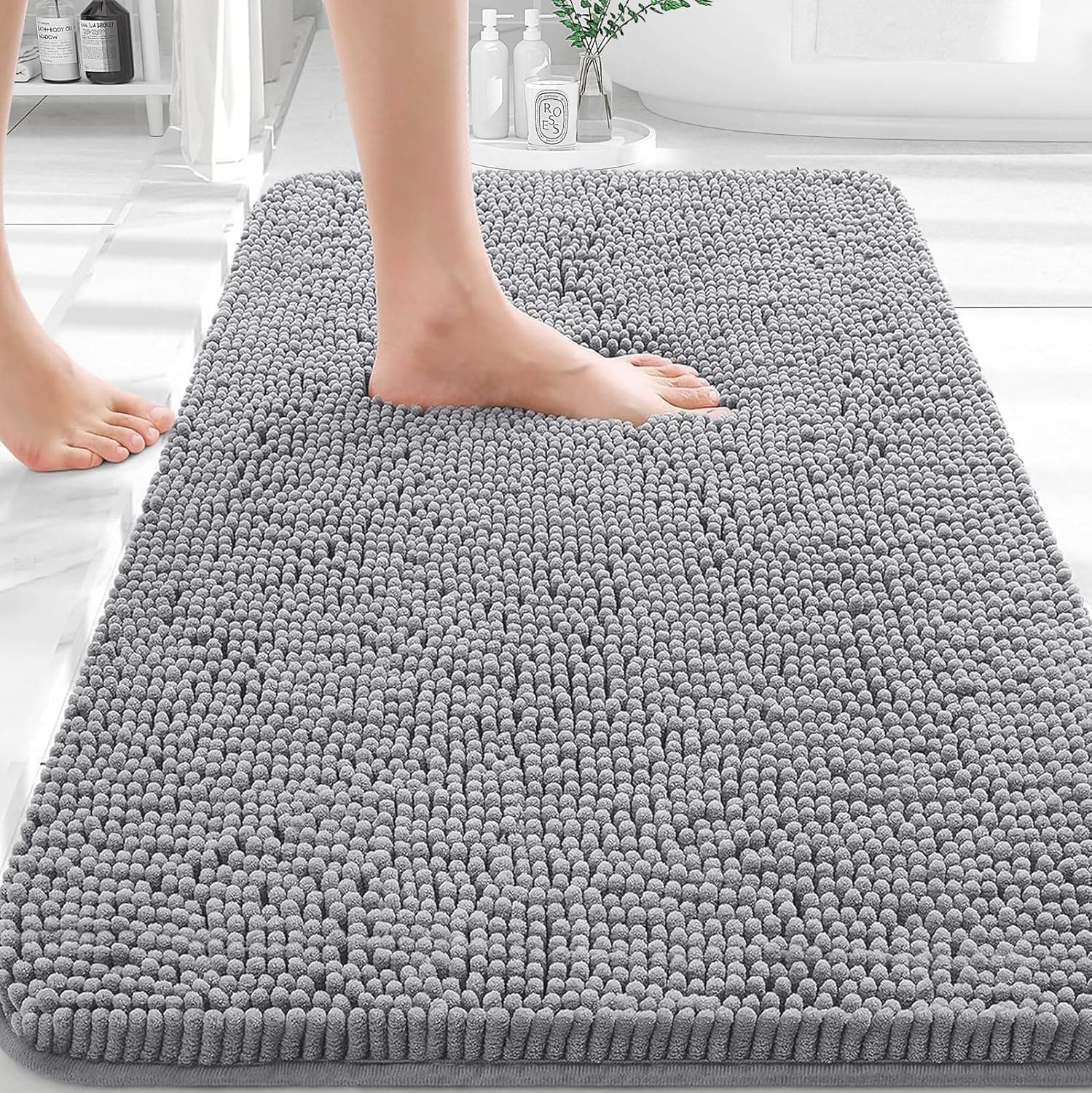
OLANLY Chenille Bath Rug, 30 x 20 in

Chenille, quick-drying, full size

The listing states all three at once: chenille pile, quick drying, and a 30 by 20 in footprint.

OLANLY Chenille Bath Rug, 30 x 20 in

Portable mount in sectionA wall seen edge on, hatched on the far side. A handled container rests on the floor line well clear of it, touching nothing.
Portable

The listing states chenille, quick-drying, rubber backing, machine washable.

A 30 by 20 inch chenille mat, which is the full-size footprint for standing in front of a tub or a vanity. The listing states quick-drying chenille, a rubber backing and machine washability. Rubber backing is a construction detail from the listing, not a grip measurement.

Stated size
30 x 20 in (per listing)
More on the OLANLY Chenille Bath Rug, 30 x 20 in

In its favor

  • Chenille has a lot of surface area, so it takes up the water that runs off you rather than spreading it around.
  • Quick-drying is stated, which matters more than absorbency in a room with poor ventilation.
  • A stated 30 by 20 in covers the step-out zone rather than sitting under one foot.
  • Machine washable per the listing, so it can go through a cycle when it starts to smell of the room.

Against it

  • The rubber backing is described, not rated; it loses grip with age and with washing.
  • Deep chenille pile holds water inside itself, so it needs to be hung up rather than left flat on tile.
  • The listing does not state a pile height, so how much it lifts a door clearance is unknown.

Best for

The main step-out spot in a bathroom that gets used every day and gets the mat washed regularly.

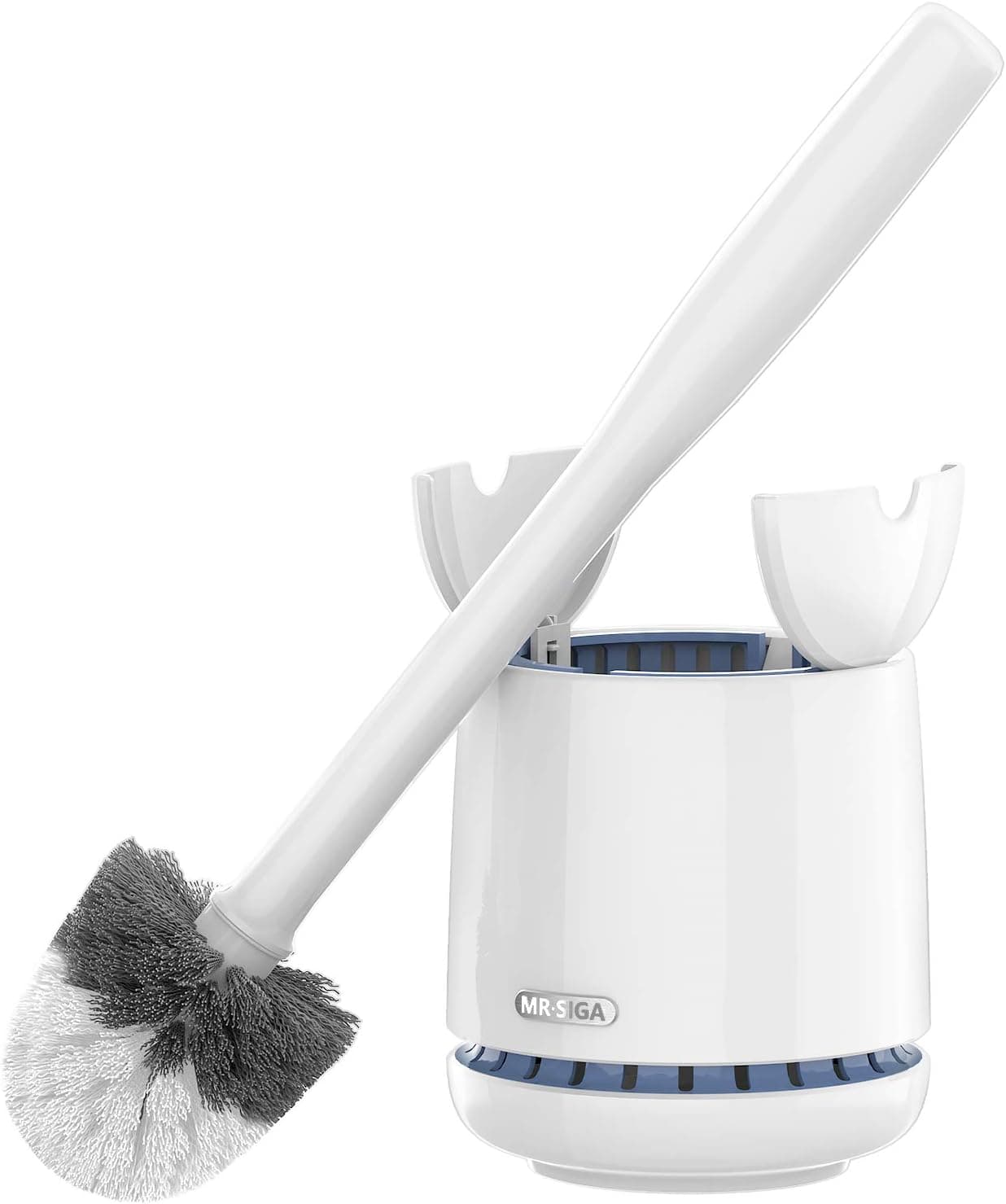
MR.SIGA Toilet Brush and Holder

Ventilated holder, replaceable head

The one listing here that states both a ventilated holder and a head you can swap out.

MR.SIGA Toilet Brush and Holder

Portable mount in sectionA wall seen edge on, hatched on the far side. A handled container rests on the floor line well clear of it, touching nothing.
Portable

The listing states an automatic lid, upgraded ventilation and a replaceable head that dries quickly.

A lidded holder with an automatic lid and ventilation stated in the listing, paired with a replaceable brush head. Ventilation is the property that decides whether a wet brush in a closed holder dries or sits in its own drip.

More on the MR.SIGA Toilet Brush and Holder

In its favor

  • Ventilation is stated as part of the holder design rather than left to chance.
  • The head is replaceable, so the handle and holder outlive the bristles.
  • An automatic lid means the holder closes without you touching it after use.
  • A quick-drying head is stated, which is the point of the ventilation.

Against it

  • A lid still slows evaporation compared with an open holder, ventilation or not.
  • Replacement heads are an ongoing purchase, and availability is not guaranteed.
  • No dimensions are stated, so fit into a narrow gap beside the toilet is unknown.

Best for

A visible bathroom where the brush should be covered but still get air around it.

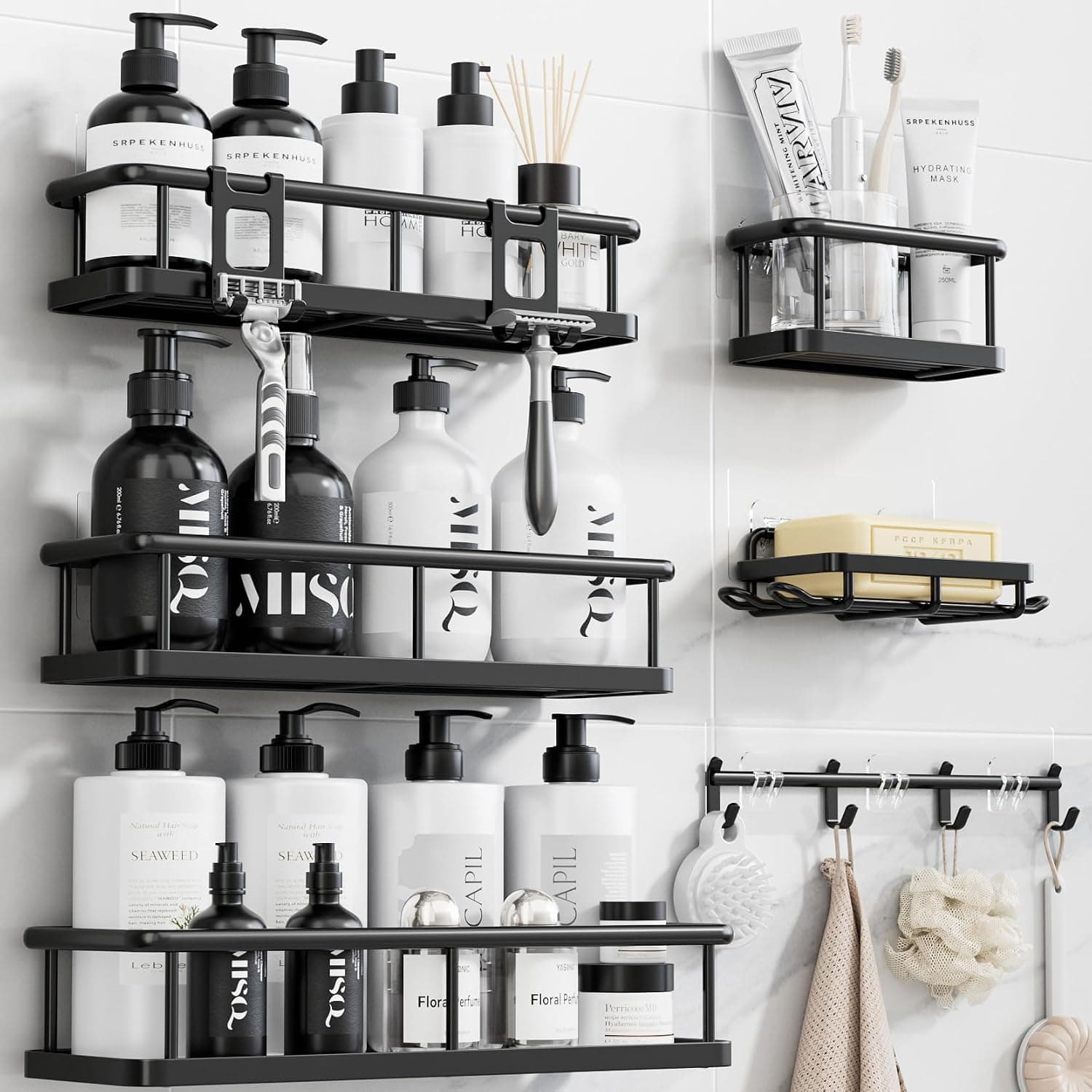
YASONIC Adhesive Shower Caddy, 6 pack

Rustproof, six pieces, soap holder

The listing states all three: a rustproof build, a six-piece count, and a dedicated soap holder.

YASONIC Adhesive Shower Caddy, 6 pack

Adhesive mount in sectionA wall seen edge on, hatched on the far side. A flat pad is pressed against the near face, carrying a shelf that projects into the room.
Adhesive

The listing states rustproof construction, a soap holder and no drilling.

A six-piece adhesive set with a soap holder, stated rustproof and stated as needing no drilling. Six pieces is a lot of adhesive pads going onto one wall, and the wall you put them on decides everything about whether they stay there.

More on the YASONIC Adhesive Shower Caddy, 6 pack

In its favor

  • Six pieces covers a whole shower wall in one purchase rather than piecemeal.
  • Rustproof construction is stated, which is the baseline requirement for anything living in spray.
  • No drilling, so a tile wall stays intact and a lease stays uncomplicated.
  • A dedicated soap holder means the bar is not sitting in a puddle on a shelf.

Against it

  • Adhesive falls when it fails, and it fails all at once with everything on the shelf.
  • No weight limit is stated on the listing, so there is no figure to load against.
  • Six pads is six chances to pick a bad spot; grout lines, silicone and textured paint are all poor ground.

Best for

A smooth, fully cured tile or glass wall where you want several small shelves and no holes.

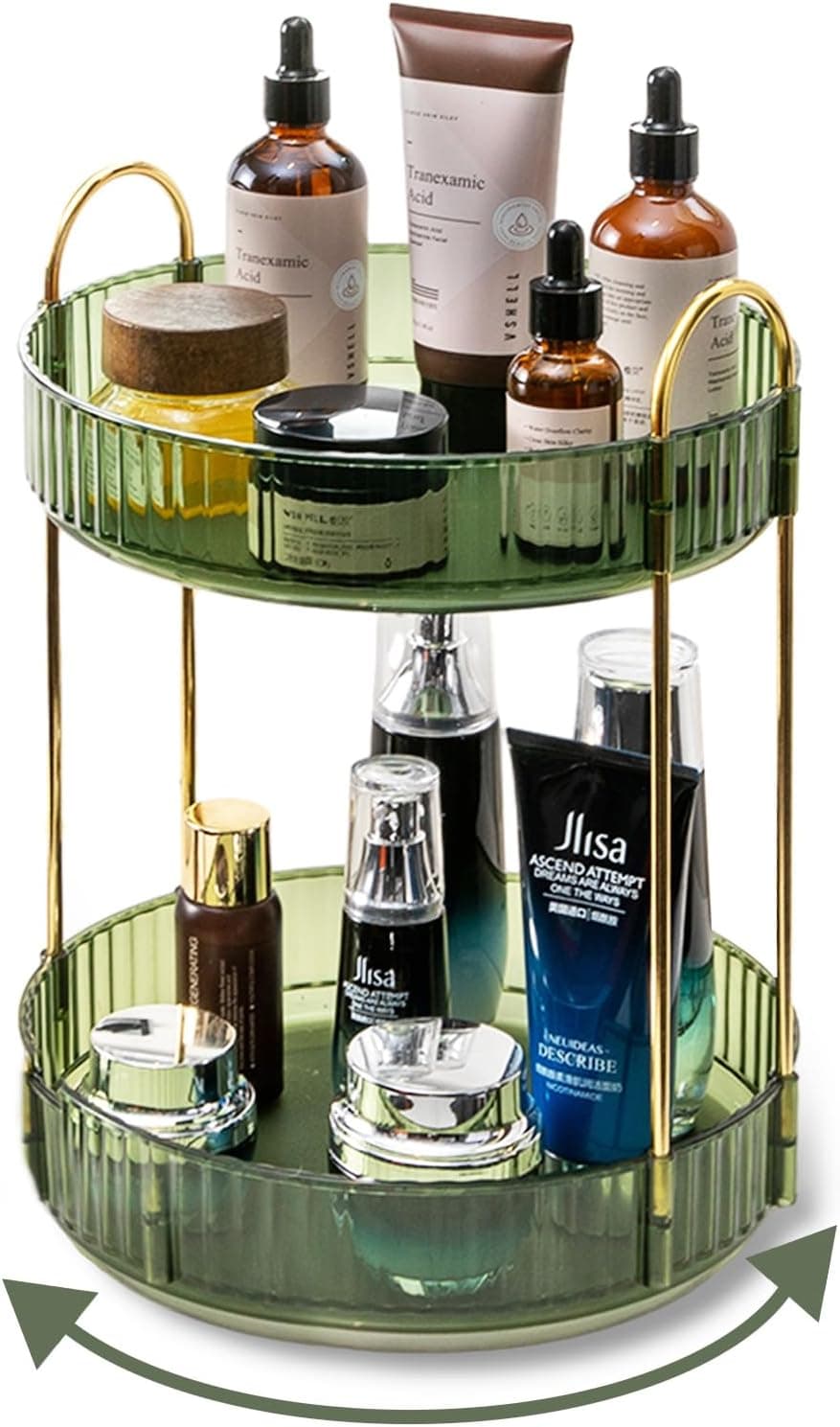
Asayuee 360 Rotating Makeup Organizer, 2 tier

Only rotating organizer listed

The single listing in this category with a spinning base; the rest are fixed shelves and trays.

Asayuee 360 Rotating Makeup Organizer, 2 tier

Portable mount in sectionA wall seen edge on, hatched on the far side. A handled container rests on the floor line well clear of it, touching nothing.
Portable

The listing states a spinning two-tier organizer for a vanity counter.

A two-tier organizer that spins, so the back row comes to you instead of you reaching over the front row. On a vanity, reaching over is exactly how bottles get knocked into a sink.

More on the Asayuee 360 Rotating Makeup Organizer, 2 tier

In its favor

  • Rotation means every item has a front position at some point in the turn.
  • Two tiers uses vertical space on a counter that is usually flat and sprawling.
  • Nothing is fastened, so it lifts off completely when you wipe the counter.
  • A round footprint fits a corner better than a rectangle does.

Against it

  • A spinning base has moving parts, and moving parts in a bathroom collect residue.
  • No dimensions are stated, so whether it clears a mirror or a backsplash is unknown.
  • Tall bottles on a rotating top tier are easy to catch on a mirror as they come round.

Best for

A crowded vanity where the things at the back are never used because nobody can reach them.

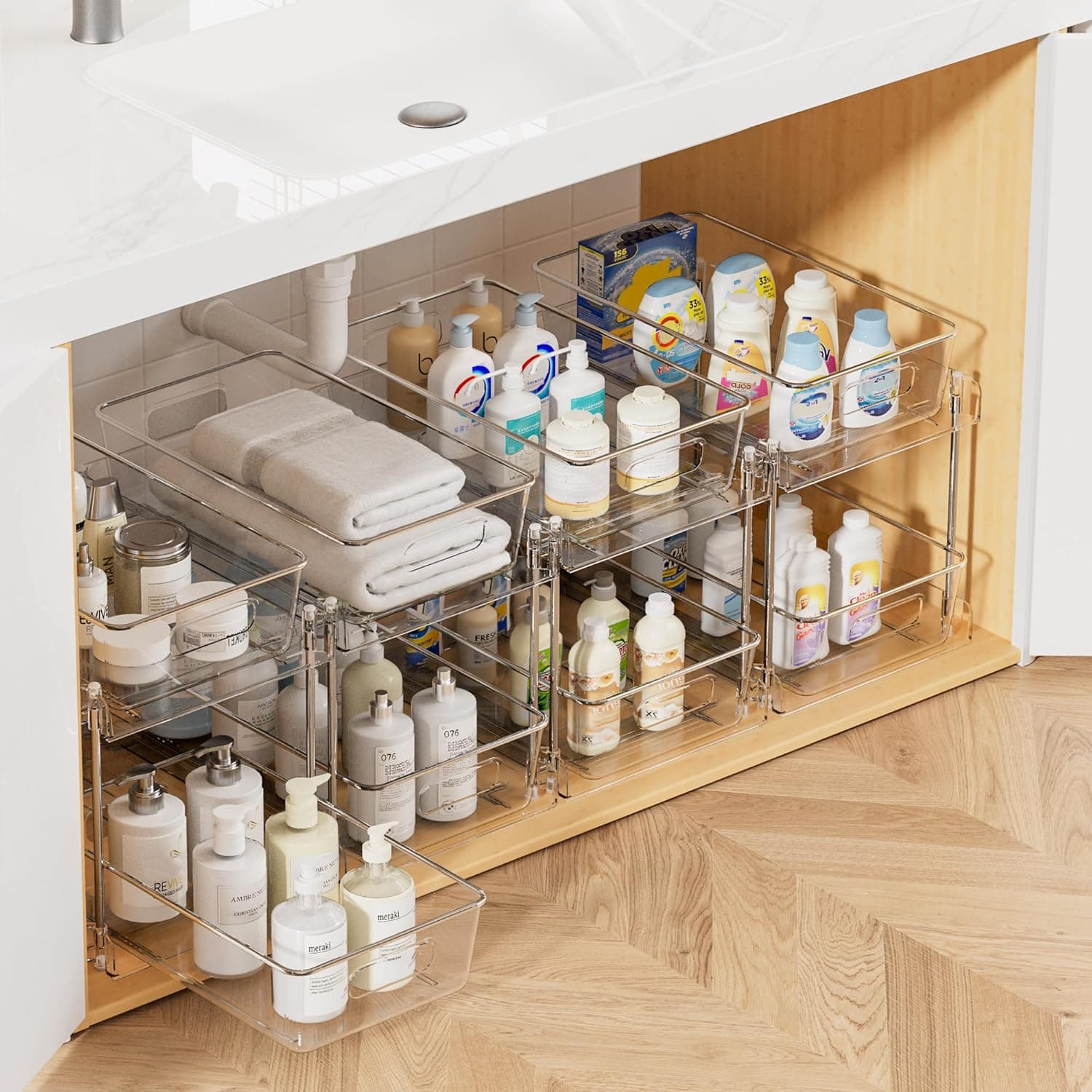
Vtopmart Pull-Out Under-Sink Organizer, 4 pack

Most drawers in one listing

Four drawers. That count appears once in this category and is the highest stated here.

Vtopmart Pull-Out Under-Sink Organizer, 4 pack

Portable mount in sectionA wall seen edge on, hatched on the far side. A handled container rests on the floor line well clear of it, touching nothing.
Portable

The listing states slide-out drawers and multi-purpose storage.

Four slide-out drawers for the cabinet under a sink, where the plumbing makes the back of the space unreachable. Sliding the shelf out is the whole point: you see the back without lying on the floor.

More on the Vtopmart Pull-Out Under-Sink Organizer, 4 pack

In its favor

  • Four drawers is the highest count stated in this category.
  • Slide-out access reaches the back of a cabinet that a plain bin does not.
  • Nothing is fastened to the cabinet, so a rental cabinet is unaffected.
  • Multiple drawers can be arranged around the trap rather than fighting it.

Against it

  • No dimensions are stated, and an under-sink cabinet is defined by the pipe running through it.
  • Loose drawers slide on the cabinet floor, which means they also slide when the door shuts.
  • The listing does not state a weight capacity.

Best for

An under-sink cabinet where everything has migrated to the front two inches.

Every listing, sorted by mount

Three things worth saying at length

Non-slip is not a measurement

Every one of the 10 mats in this catalog uses some form of the words non-slip, non-skid or rubber backing. Not one attaches a figure, a test method or a standard to it. Those words describe a compound bonded to the underside of a mat, and the compound stiffens with age, warms and softens in a hot room, and loses grip after every wash.

What a mat genuinely does is take water off your feet so that less of it reaches the floor. That is real, useful, and a different claim from making a floor safe. Nothing on this site can prevent a fall.

A pressure-sensitive pad bonds to the outermost layer of whatever it touches. On glazed tile that layer is fired glass, and it wins. On painted drywall that layer is a film of paint sitting on a paper face, and the pad wins instead: it leaves with a paint-shaped patch on its back, and sometimes with the paper too.

This is not a failure of the product and it is not something a technique fixes. It is the ordinary behavior of a bond that is stronger than the surface it is bonded to. Budget for touch-up paint before the first pad goes on the wall.

Adhesive takes the paint with it

Why a spice rack is in this catalog

One listing in the pull-out category is a bamboo spice rack for a kitchen cabinet. It is not a bathroom product, and it is labeled as a kitchen product in its subgroup heading, on its card, and in that category’s questions.

It stays because its slide-out mechanism is exactly the idea the under-sink organizers use, and because quietly deleting it would have been the tidier and less honest option. A catalog that only contains things that fit its own categories neatly is a catalog that has been edited rather than checked.

Method

How this site is written

  1. Nothing on this site has been tested. There is no lab, no load rig and no sample of any product in the catalog.
  2. Every specification is quoted from the listing it belongs to and is attributed with the words the listing states. Where a listing gives no figure, this site says the manufacturer does not state one rather than estimating.
  3. Anti-tilt system, anti-tip device, 150 lb capacity, non-slip, non-skid, antibacterial: all seller language, all reported as seller language, never repeated as fact and never used to rank one product above another.
  4. No drilling instructions appear anywhere here, and no advice about what your tenancy agreement permits. Both of those are for people who can see what a web page cannot.
  5. The catalog was corrected rather than tidied. Two listings arrived filed as counter organizers and are adhesive shower shelving, so they were moved. One listing is a kitchen spice rack and is labeled as one everywhere it appears.
  6. Prices and star ratings appear nowhere. Both change constantly, and neither tells you anything about how a fixture attaches to a wall.

To repeat what is at the top of this page, in case you arrived partway down it: every product link here is an affiliate link to Amazon, and a qualifying purchase earns this site a commission. Prices and availability are not shown on this site because they change and because this is not a price comparison.

31 of the 46 listings here attach to nothing at all, which is worth knowing before you start looking at walls.